-
omega3/omega6
Dr, I am being told by someone I know that I should take a blood test that meaures the ratio of omega 3/omega 6 . The idea is if that ratio is out of whack , its a sign of inflamation in the body
Do you have any comments on that test ? worthwhile?
4 Comments-

Sure, that’s not a bad indirect measurement to use as a decent barometer of inflammation load. I’m sure something like TG/HDL ratio given actual empirically derived evidence proving how it’s the most potent predictor of incident disease along with its ease of measurement through bloody would be way better. Or simply even something like cRP. But either way, all these metrics should be correlated to some degree. You can get the omega panel if you want though. It should look stellar especially with this final formulation of just niacin and tryptophan. There are meta-analyses of double-blinded randomized controlled human clinical trials demonstrating niacin’s unmatched safety and efficacy against most of these inflammation measures as there is including TG, HDL, and cRP, as well as some trials, if I recall, focusing on this very omegas ratio, which I will try to find.here soon
-

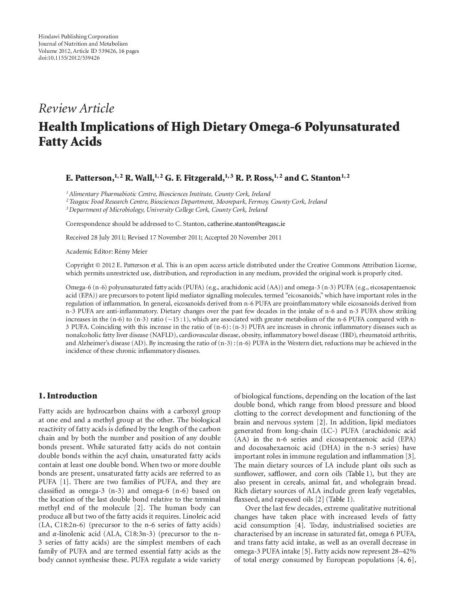
Health implications of high dietary omega-6 polyunsaturated Fatty acids.
Patterson, E., Wall, R., Fitzgerald, G. F., Ross, R. P., & Stanton, C. (2012). Journal of nutrition and metabolism, 2012, 539426.
2012 Apr 5
DOI: 10.1155/2012/539426 (https://doi.org/10.1155/2012/539426)1-
Forgive me, but I just typed out four hours-worth of literature review and summary, and it all just got wiped out because I accidentally pressed a button on my keyboard. I do not have the patience to type everything out again, nor the time. So here are some key excerpts. I hope you are not supplementing these omegas. If so, good luck!
“As a low ω-3/ω-6 ratio is associated with a risk for CVD, increasing the ratio by supplementary ω-3 PUFAs has been posed as a treatment target (42). In our study, we see that the DHA/AA ratio has increased toward the anti-inflammatory DHA side without supplementary ω-3 PUFAs. We have seen this increased DHA/AA ratio in both the ex vivo adipocyte PUFA secretion profile and in the in vivo plasma NEFA profile of niacin-treated mice. These effects of niacin on adipose tissue and plasma PUFAs and oxylipins pose a potential contributing mechanism by which niacin treatment reduces cholesterol levels and CVD risk. Although we used mice in this study that are human-like with respect to lipoprotein profile, it remains to be investigated whether there are changes in the plasma DHA/AA ratio in humans treated with niacin.” — it actually has been, but I cannot find the trial anymore with actual immediate release nicotinic acid and only a bunch of extended release bullshits.
“prolonged niacin treatment of our hyperlipidemic mouse model with niacin resulted in upregulation of the entire biosynthesis of unsaturated fatty acids pathway in gWAT, increased ω-3 PUFA secretion from the adipocytes, and an increased plasma level of ω-3 PUFAs and their anti-inflammatory oxylipins, which together point toward an atheroprotective plasma profile induced by prolonged niacin treatment.”
https://www.jlr.org/article/S0022-2275(20)36693-1/fulltext
+
The effect of niacin on inflammatory markers and adipokines: a systematic review and meta-analysis of interventional studies
https://link.springer.com/article/10.1007/s00394-024-03425-8Now tryptophan:
Across patients, a higher ω-6:ω-3 ratio associated with higher KYN/TRP, strengthening the link between PUFA balance and TRP catabolic pressure.
Author claim to be first to show:
“association between the kynurenine pathway (KYN/TRP ratio) and the omega-6/omega-3 FA ratio”https://www.frontiersin.org/journals/psychiatry/articles/10.3389/fpsyt.2024.1347178/full
In these cohorts, activated Trp metabolism (lower Trp, altered KP/indole outputs) and lower ω-3 (and ω-3:ω-6) travel together, consistent with an inflammatory/immune-metabolic milieu that can push Trp down the kynurenine route while ω-3 status is low. Independent work has likewise linked KYN/TRP ratio to the ω-6:ω-3 ratio, supporting an axis between Trp catabolism and PUFA balance.
https://www.mdpi.com/1648-9144/59/2/413
…
“The present observations confirm the findings of Hegsted et ai. (7) that the tryptophane requirement of the growing rat under normal conditions is considerably less than the level of 0.2 per cent set by Rose (8). It should be noted, however, that the diet used by Rose in establishing this level was a relatively high fat, high calorie diet, while the diets employed here are low in fat.”
https://www.jbc.org/article/S0021-9258(17)41384-6/pdf
———
HIGHLIGHTS/TAKE-HOMES:
KYN/TRP ratio (↓).
In depressed youths, the ω-6:ω-3 ratio positively associates with KYN/TRP ratio; ω-3 supplementation modestly boosted serotonin-pathway flux, while ω-6 mainly pushed KYN/TRP up. With the nicotinic acid part of InfinaLife restoring NAD⁺ and lowering inflammatory drive, this in turn spares L-tryptophan to have to substitute for its lack in lieu down the kynurenine pathway and so KYN/TRP should fall; concurrently improving ω-3/ω-6 balance.
While modifications to diet or supplementation of omega formulas in attempts to lead to improved modifications of the omegas ratio, may be conceptualized as an alternative or additional way to help, it seems that whatever arduous way that that would be accomplished to any degree would, once you actually break down that diet, be another representation of trending to that degree to more tryptophan or niacin in the diet, and much more readily, efficiently, powerfully, cleanly, and easily manifested through nicotinic acid + free-form L-tryptophan supplementation, whilst keeping whatever diet (ideally as non-processed as possible) suits you best.
Bottom line: treat ω-3/ω-6 metrics as part of a multi-marker response signature. NA+Trp should lower inflammatory pressure (CRP, TNF-α), improve adipose tone (adiponectin, NEFA), and ease TRP catabolism (KYN/TRP ↓); ω-3/ω-6 composition will follow suit and move towards more favorable
-
-
Review
The importance of the ratio of omega-6/omega-3 essential fatty acids.
Simopoulos A. P. (2002). Biomedicine & pharmacotherapy = Biomedecine & pharmacotherapie, 56(8), 365–379.
2002 Oct
DOI: 10.1016/s0753-3322(02)00253-6 (https://doi.org/10.1016/s0753-3322(02)00253-6)1
-