-

sandra-keightleybigpond-com posted an update
Hi Dmitry
Question… Would the speach condition of stuttering possibly get relief from this.
Cheers Jim
Dr.Kats2 Comments-

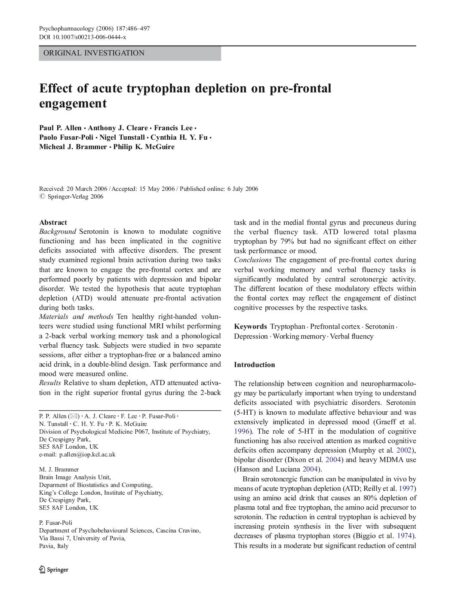
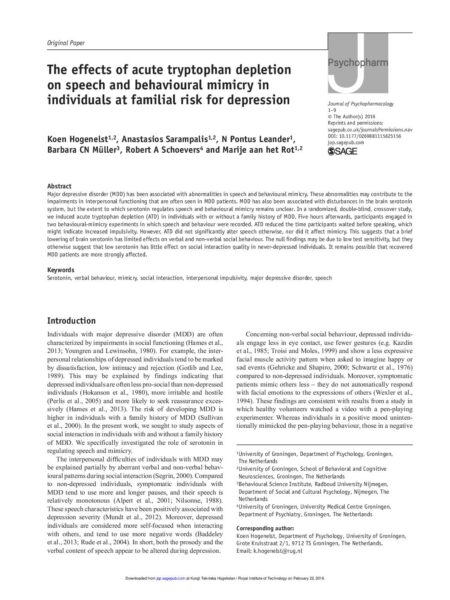
“Though most speech characteristics were unaffected, unexpectedly we found that preparation time before speech was significantly shorter after ATD [acute tryptophan depletion] than after the control mixture. We speculate that this may reflect increased interpersonal impulsivity. This would be in line with studies showing increased impulsive behaviour after ATD in social settings (Cleare and Bond, 1995; Crockett et al., 2010) as well as in non-social settings (LeMarquand et al., 1999; Walderhaug et al., 2002). It has been suggested that impulsiveness associated with low serotonin may undermine social functioning (Wood et al., 2006). Moreover, impulsiveness during social interactions has been associated with increased quarrelsomeness and, in more impulsive individuals, with decreased agreeableness (aan het Rot et al., 2015).”
^From the last attached PDF, which was a double-blinded, randomized controlled human trial:
…
So when serotonin levels drop, you can see two opposite-seeming effects in speech:
Faster start times (due to impulsivity and reduced inhibition)
But often less controlled articulation or higher emotional tone
Adequate free-form L-tryptophan supports serotonin synthesis → serotonin maintains optimal activation of prefrontal and speech-motor circuits → better control and fluency potential.
How this ties into speech and stuttering
Stuttering and speech dysfluency often involve a fine-tuned balance between:
• Motor initiation (how quickly you start talking)
• Cognitive control (planning what to say)
• Emotional regulation (staying calm while speaking)
If serotonin drops:
• Emotional regulation weakens → higher tension and reactivity.
• Motor timing may become erratic → speech starts too soon, coordination falters.
• Overall fluency may look faster but feel less controlled or more pressured.
1 -

Thankyou Dymitry, I’ll pass this on to him
-