-
^ “Interestingly, in this study, glutamine effect seems to be dependent on basal expression of tight junction proteins suggesting that lower is the expression of tight junction protein, higher is the effect of glutamine.”
^ You don’t say?!?!?!
Niacin Improves Intestinal Health through Up-Regulation of AQPs Expression Induced by GPR109A
https://www.mdpi.com/1422-0067/23/15/8332/htm
mdpi.com
Niacin Improves Intestinal Health through Up-Regulation of AQPs Expression Induced by GPR109A
(1) Background: Changes in the expression of aquaporins (AQPs) in the intestine are proved to be associated with the attenuation of diarrhea. Diarrhea is a severe problem for postweaning piglets. Therefore, this study aimed to investigate whether niacin could alleviate … Continue reading
4 Comments-

^ “Indeed, glutamine deprivation in IECs was associated with a loss of occludin, claudin-1 and zonula occludens-1 expression leading to impaired paracellular permeability, while glutamine supplementation maintained or restored it.”
https://sci-hub.ru/10.1097/mco.0000000000000339-
^ “It was determined that intestinal permeability also was influenced by the upregulation of occludin and claudin-3 in the ileum and occludin, claudin, and ZO-1 expression in the colon. Using Western Blot analysis, ERK1/2, Akt, and P38 were phosphorylated, which indicated activation of the GPR109A pathway. ”
https://www.ncbi.nlm.nih.gov/labs/pmc/articles/PMC7824468/
-
After feeding nacin, the blood milk barrier of LPS injected WT mice was significantly repaired, the expression of ZO-1, Claudin-3 and Occludin was significantly increased, and their localization was partially restored. In GPR109A-/- mice, the fluorescence intensities of ZO-1, Claudin-3 and Occludin were weaker than those in WT.
Moreover, we found that the location of ZO-1, Claudin 3 and Occludin in GPR109A-/- mice’s mammary gland were changed.
After LPS injection, niacin could not restore the expression of above proteins in GPR109A-/- mice.
To explore the effect of GPR109A on TJs, we detected the protein expression and fluorescence intensity of Occludin, ZO-1 and Claudin 3. The results showed that the expression of Occludin, Claudin 3 and ZO-1 were significantly increased after niacin treatment.
The fluorescence intensities of Occludin, ZO-1 and Claudin-3 significantly increased after niacin treatment for 24 h.
These results indicate that the levels of Occludin, Claudin-3 and ZO-1 in mammary epithelial cells significantly increased after GPR109A was activated and significantly decreased after GPR109A was knocked down.
The fluorescence intensity of these proteins was consistent with the western blotting results.
The transmission electron microscope (TEM) results also showed that the TJs were strengthened after GPR109A was activated.To clarify the mechanism of how GPR109A helps repair the integrity of the blood-milk barrier. In WT mice, the fluorescence intensity of Claudin-3, ZO-1 and Occludin in LPS + niacin group was significantly stronger than that in LPS group, suggesting that niacin repairs tight junction destroyed by LPS.
At the same time, we also found that LPS significantly reduced the fluorescence intensity of ZO-1, occludin and Claudin-3 in mammary gland. Before LPS injection, Claudin-3 and ZO-1 were co-located with occludin in the most-apical region of mammary epithelial cells (MEC).
We also found that ZO-1 and Claudin-3 in the most-apical region of the junction of MECs could not co-locate with Occludin after injection of LPS 24 hours. After feeding niacin, the blood milk barrier of LPS injected WT mice was significantly repaired, the expression of ZO-1, Claudin-3 and Occludin was significantly increased, and their localization was partially restored. In GPR109A-/- mice, the fluorescence intensities of ZO-1, Claudin-3 and Occludin were weaker than those in WT mice.
Moreover, we found that the location of ZO-1, Claudin 3 and Occludin in GPR109A-/- mice’s mammary gland were changed.“To further study the effect of GPR109A on the blood milk barrier, we detected the levels of ZO-1, Occludin and Claudin 3. In WT mice, the levels of ZO-1, Occludin, and Claudin 3 in the LPS group were significantly downregulated, while the levels of these proteins was significantly increased after niacin treatment. In GPR109A-/- mice, we found that the expression of Claudin 3, ZO-1 and Occludin was very low.”
“It was determined that intestinal permeability also was influenced by the addition of sodium butyrate, with upregulation of occludin and claudin-3 in the ileum and occludin, claudin-3, and ZO-1 expression in the colon. Using Western Blot analysis, ERK1/2, Akt, and P38 were phosphorylated, which indicated activation of the GPR109A pathway. ”
https://www.ncbi.nlm.nih.gov/labs/pmc/articles/PMC7824468/-
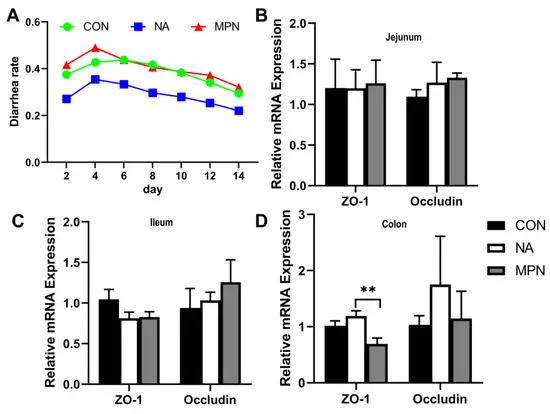
^ “This is consistent with our findings that blocking the GPR109A receptor increased the rate of diarrhea in piglets by reducing colonic ZO-1.”
Niacin Improves Intestinal Health through Up-Regulation of AQPs Expression Induced by GPR109A
https://www.mdpi.com/1422-0067/23/15/8332/htm
-
-
-
-