-
Methionine transsulfuration pathway is upregulated in long-lived humans
https://www.sciencedirect.com/science/article/abs/pii/S0891584920316397
“Available evidences point to methionine metabolism as a key target to study the molecular adaptive mechanisms underlying differences in longevity. Our findings demonstrate the presence of a specific plasma profile associated with human longevity characterized by an enhanced transsulfuration pathway and tricarboxylic acid (TCA) cycle intermediates, as well as a reduced content of specific amino acids. Furthermore, our work reveals that centenarians maintain a strongly correlated methionine metabolism, suggesting an improved network integrity, homeostasis and more tightly regulated metabolism. We have discovered a particular methionine signature related to the condition of extreme longevity, allowing the identification of potential mechanisms and biomarkers of healthy aging.”
 2 Comments
-

^ Look at above image: you see the question mark above the dotted-line arrow leaving from the right side of Cysteine traveling to Pyruvate? Well, I believe it involves the metabolization of lipoic acid, which likewise may also represent the other question mark (from above the other dotted-line arrow leaving from the left side of Cystathionine traveling to Succinyl-CoA!
-
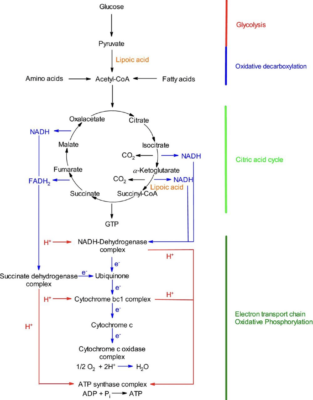
^ See figure below (from https://link.springer.com/article/10.1007/s40828-019-0091-6)
…
Caption for it:
Under aerobic conditions, cells generate chemical energy (i.e. ATP) by converting carbohydrates, amino acids (e.g. alanine, valine, isoleucine and leucine) and fatty acids into carbon dioxide, (when applicable) ammonia and water. This process comprises several steps: (1) glycolysis, amino acid and fatty acid degradation; (2) oxidative decarboxylation of pyruvate; (3) citric acid cycle; (4) electron transport chain and oxidative phosphorylation
-
-