-

Dr.Kats posted an update
8 months ago (edited)
Realize the key of Tryptophan coming in exogenously as the FREE-FORM Tryptophan
“Because of the low fractional extraction of free tryptophan in the brain, the synthesis of 5-HT will be dependent only upon the free pool of tryptophan.”
https://pmc.ncbi.nlm.nih.gov/articles/PMC1133271/

pmc.ncbi.nlm.nih.gov
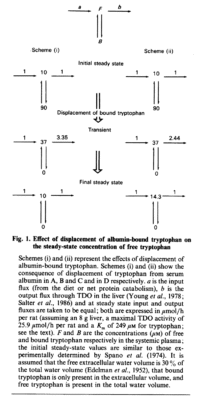
Models of tryptophan catabolism and binding to serum albumin are presented to explain the observed effect of displacement of tryptophan from albumin on the concentrations of free and bound tryptophan and on the rate of 5-hydroxytryptamine (5-HT) ...
don and Anna15 Comments-

And not just that:
“Research is uncovering tryptophan’s role beyond mood regulation—it’s becoming vital for muscle recovery. Studies show enhanced protein synthesis linked to tryptophan intake. As recovery nutrition evolves, expect this amino acid to take center stage by 2025.”
https://x.com/signal_synapse/status/1983982735606620572?s=46
1 -
“the results demonstrate that for there to be sustained increases in free plasma tryptophan after displacement of bound tryptophan, there must be rapid dissociation of tryptophan from albumin (compared to the transit time of tryptophan through the major catabolic organ, the liver) and there must be a significant fractional extraction of the free pool during passage through the liver. The bound pool of tryptophan is therefore important in the regulation of tryptophan catabolism in the liver but only indirectly for the synthesis of 5-HT in the brain.”
1 -
Now imagine, this limited-as-shit as it is incoming supply of free-form L-tryptophan, simultaneously having to excessively deplete/oxidize down to NAD+ in lieu of nicotinic acid supplementation. What then, do you have left for serotonin-melatonin and for protein synthesis?!?!?
-
“Since the output flux is now greater than the input flux, the concentration of free tryptophan will decrease until steady-state is obtained. It is clear that, in A, B and C, displacement of bound tryptophan cannot produce sustained increases in free tryptophan concentration (and hence brain 5-HT synthesis); this is because the rates of appearance and of catabolism of tryptophan at steady-state must be equal (by definition), and only the free tryptophan concentration determines the rate of catabolism under these circumstances.”

-
“It can be calculated that complete removal of the bound tryptophan will have only very small direct effects on tryptophan concentrations within the brain and thus on 5-HT synthesis.”
1 -
“In conclusion, the experimental observations of sustained increases in tryptophan concentration when bound tryptophan is displaced are explicable only when there is both a large fractional extraction of free tryptophan (during passage through the liver) and a rapid dissociation of tryptophan from serum albumin. In contrast, in tissues such as the brain, in which there is a low fractional extraction of free tryptophan, the albumin-bound pool of tryptophan will not be a significant factor”
-
“As observed previously (Bender et al. 1982), the animals fed on the diets providing tryptophan as the only precursor of nicotinamide nucleotides grew faster than those fed on low-tryptophan diets providing an adequate or more than adequate amount of nicotinamide or nicotinic acid, suggesting some degree of growth restriction by the low amount of tryptophan provided by these diets.” … as Krehl showed repeatedly too
-
Good luck trying to increase your “tryptophan content” in diet to meet that tryptophan need, if that’s even possible (certainly not via the bound-protein form digesting endogenously to provide it, if that is even possible given it is not acid-hydrolyzed degraded out before we consume it, and so then depending on the free-fraction that is unmeasured/unknown coming you hope with that extra bound-protein tryptophan?) … versus simply just that small proportional fraction of free-form L-tryptophan exogenously (with accompanying nicotinic acid).
-
Oh and that free-form fraction — if any — would be degraded out by acid too …. And with just more time (since butchering/harvest) … not to mention, needing to catch up on years, decades, generations of paucity in that readily available free-form L-tryptophan, with sufficient accompanying nicotinic acid supplemented… if you actually disentangle what nourishing and sustaining growth and metabolism entails here, restoring or promoting health and function, you realize, is not a feat that can be even fathomed to be accomplished by way of any other route/fashion than along the lines of what I am showing you … While comprised of something so simple as consistently sufficient intakes of a pair of two identified limiting nutrient factors that have been largely absent, nicotinic acid with appropriately accommodating amount of free-form L-tryptophan in proportion, we simply cannot have a serious conversation of what is actual health and longevity, without such required intervetion as the bedrock.
-
-
-
“it becomes apparent that the relative availability of plasma tryptophan to tissues is much less than that of other amino acids. The finding, described elsewhere, that tryptophan in serum or plasma can be present as free and bound (to plasma albumin) is unique among amino acids,44 and this further limits or controls the availability of tryptophan from the blood to organs or tissues, especially the brain”
https://api.pageplace.de/preview/DT0400.9781420036794_A25123323/preview-9781420036794_A25123323.pdf -
-
-
-
Elucidating the underlying mechanism of amino acids to regulate muscle protein synthesis: Effect on human health
https://www.sciencedirect.com/science/article/pii/S0899900722002106
-
“It was concluded that tryptophan has the potential to regulate muscle protein synthesis in a manner beyond serving simply as a component of protein.”
https://www.sciencedirect.com/science/article/abs/pii/S0022316622168902?via%3Dihub
-
-